What does a data architect do?
What a data architect does, why the role is becoming more important, and how good data architecture reliably supports BI, analytics, and AI.

Lammert Kiers
Data Architect
Data Engineering
What does a data architect do?
A data architect designs the way data flows through an organization. This goes beyond technology. The role connects business goals, data sources, platform choices, governance, security, and analytics into one cohesive data architecture.
In many organizations, data grows organically. Departments choose their own tools, reports are built on exports, definitions differ per team, and data sources become fragmented. That works as long as the organization is small, but becomes risky as soon as data becomes crucial for management information, compliance, automation, or AI.
A data architect prevents that proliferation. He or she determines how data is stored, integrated, secured, modeled, and made available to users. In doing so, the data architect forms the bridge between strategy and execution.
Why the role of data architect is becoming increasingly important
The volume of data within organizations continues to grow. At the same time, teams expect faster insights, better dashboards, and increasingly, AI features. Without a solid architecture, a shaky foundation is created: reports contradict one another, data quality is unclear, and new use cases consistently require a lot of time.
With platforms like Microsoft Fabric, Azure, and Power BI, the technical toolkit is becoming more powerful, but also more strategic. The question is not just which tool you use, but how you deploy those tools together without creating new data silos.
A data architect helps organizations make those choices deliberately. Which data belongs in a lakehouse? When is a data warehouse better? Which definitions belong in the semantic model? How do we manage access to sensitive information? And how do we ensure that AI can work with reliable context in the future?
The primary responsibilities of a data architect
The exact implementation varies by organization, but the core remains the same: ensuring that data is available reliably, securely, scalably, and usability. A data architect therefore often works together with management, IT, data engineers, BI consultants, security, finance, and operations.
· Translating data strategy into a technical and organizational architecture.
· Designing data platforms for storage, integration, transformation, and reporting.
· Helping to set up governance, security, and ownership of data.
· Guiding teams in scalable data models, definitions, and platform choices.
Data architecture: what does it cover?
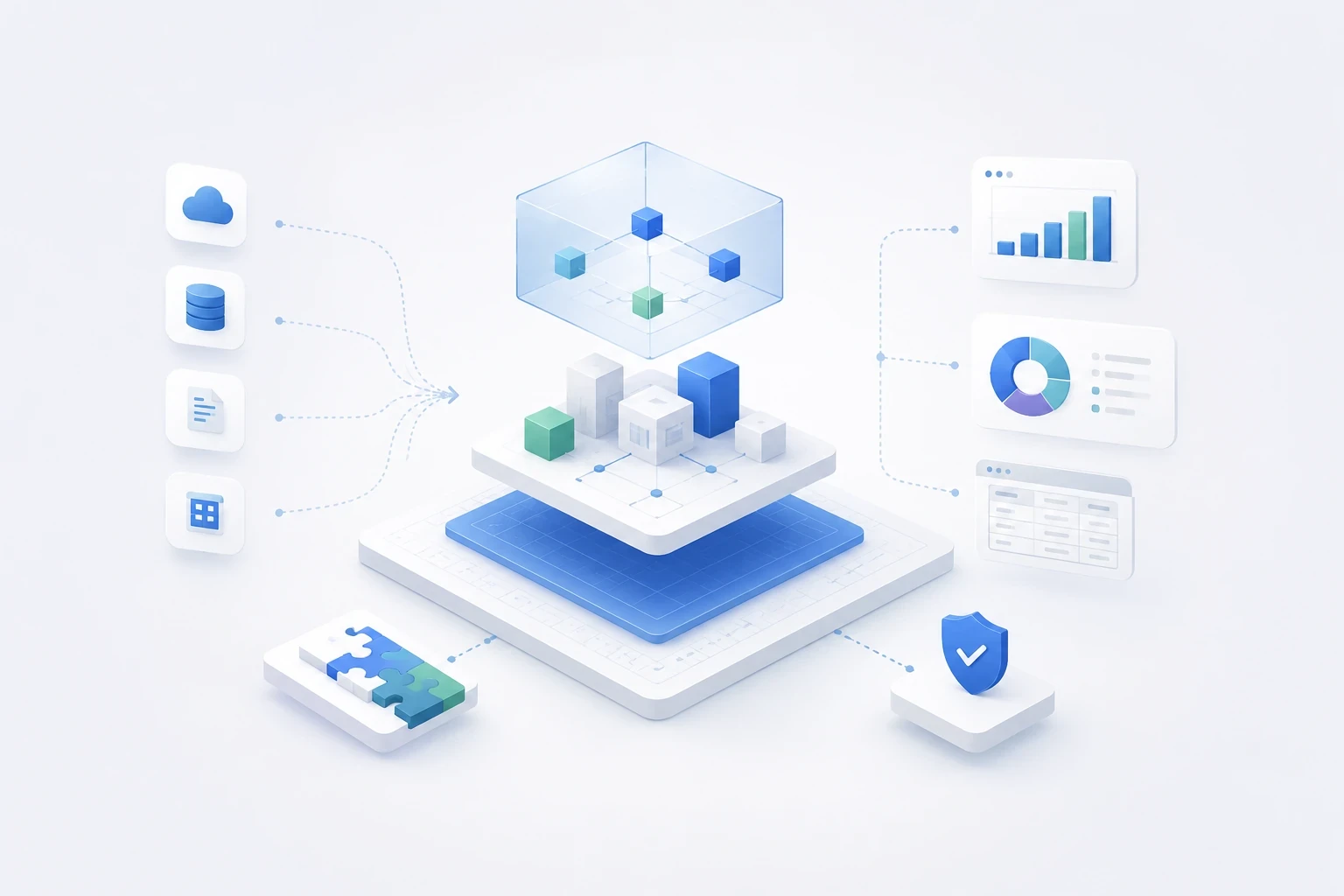
Data architecture describes how data moves from source to consumption. This starts with operational systems like ERP, CRM, finance, and planning. This is followed by integration, storage, transformation, modeling, and distribution to dashboards, reports, AI applications, or operational processes.
Layer | Examples | Role of the data architect |
Source data | ERP, CRM, Excel, APIs, databases | Determining which sources are authoritative and how data is unlocked. |
Integration | Pipelines, ETL/ELT, Data Factory | Designing how data is retrieved reliably and repeatably. |
Storage | Data lake, lakehouse, data warehouse | Choosing structure, granularity, history, and storage strategy. |
Modeling | Dimensions, facts, semantic models | Defining and establishing relations and KPIs scalably. |
Consumption | Power BI, Excel, apps, AI agents | Ensuring users receive secure and understandable data. |
Data architect versus data engineer versus BI consultant
The terms are sometimes used interchangeably, but the roles differ. In small organizations, one person can combine multiple roles. In larger environments, responsibilities are usually divided more explicitly.
Role | Focus | Example of activities |
Data architect | Design and direction | Target architecture, platform choices, governance, high-level data modeling. |
Data engineer | Build and manage | Developing pipelines, transforming data, optimizing performance. |
BI consultant | Insights and adoption | Power BI dashboards, KPI definitions, user requirements, and training. |
Data analyst | Analysis and interpretation | Investigating trends, conducting ad-hoc analyses, and answering business questions. |
The data architect, therefore, is not always the one who builds everything themselves. The value lies in providing direction, making choices explicit, and ensuring that individual solutions together form one future-proof whole.
When do you need a data architect?
Not every organization immediately needs a full-time data architect. But there are clear signals that architecture is becoming more important. Especially when data projects lead to recurring issues, it is wise to have an architect take a look.
· Reports contradict each other because definitions differ by department.
· New dashboards take a lot of time because data sources are constantly being reconnected.
· There is a need for Microsoft Fabric, Azure, or a modern data warehouse, but the target architecture is unclear.
· AI initiatives stall because data is not reliable, findable, or well-described.
A data architect does not always have to start a major trajectory. Sometimes a brief architecture scan is already enough to clarify where the biggest risks lie and which steps will deliver value first.
The role of a data architect with Microsoft Fabric
Microsoft Fabric brings data engineering, data science, data warehousing, real-time analytics, and Power BI together into a single SaaS platform. According to Microsoft, Fabric revolves around integrated workloads and OneLake as the central logical data lake for the organization. That makes it powerful, but also demands deliberate architectural choices.
In Fabric, architecture is mainly about cohesion. Which workspaces do you use? How do you set up domains? When do you use a lakehouse, warehouse, or semantic model? Which data is certified? And how do you prevent teams from still building their own separate islands?
A data architect helps to use Fabric not just as a toolset, but as a platform. That means: agreements on storage, naming conventions, security, lineage, governance, ownership, and reuse of datasets.
The role of a data architect with Power BI
At the front-end, Power BI looks mostly like a dashboard tool, but at an organizational level, it is a key component of the data architecture. Semantic models, workspace structures, certified datasets, row-level security, and report governance determine how reliable and scalable the BI environment becomes.
When every department creates its own datasets, multiple versions of the truth quickly arise. A data architect helps determine which data models are central, which teams are allowed to develop themselves, and how self-service BI can take place securely.
Governance, security, and compliance
Data architecture is not just about efficiency, but also about trust. Organizations must know who has access to which data, which sources are official, how sensitive information is protected, and how changes are managed.
· Ownership: who is responsible for source data, definitions, and quality?
· Access: who is allowed to see, export, or share which data?
· Lineage: where does data come from and which reports use that data?
· Classification: which data is sensitive, confidential, or business-critical?
Without governance, a data platform can grow rapidly, but not securely or manageably. With governance-by-design, agreements are incorporated into platform choices and development processes from the very beginning.
Data architecture as the foundation for AI
AI makes the role of data architect even more critical. Models, copilots, and agents depend on context. If data is scattered, contradictory, or poorly described, AI outcomes become less reliable. AI-ready data therefore does not start with a model, but with architecture.
A data architect ensures that AI can build on reliable and well-described data. Think of consistent definitions, access rights, metadata, data quality, and a clear separation between raw data, validated data, and business-ready datasets.
In modern Microsoft environments, this comes together in Fabric, Power BI, Azure, and governance via Microsoft Purview. The architect determines how these components work together and how organizations can experiment safely without losing control.
What does a data architecture trajectory look like?
A trajectory usually begins with gaining insight into the current situation. What data sources are there? Which reports are business-critical? Where do errors or delays occur? Which technology is already present? And what goals does the organization have for BI, analytics, and AI?
1. Inventory of systems, reports, data flows, and bottlenecks.
2. Design of target architecture, priorities, and platform choices.
3. Elaboration of governance, security, data models, and development standards.
4. Phased realization with dashboards, pipelines, training, and handover.
The result is not a theoretical document that disappears into a drawer. A good data architecture is practical and actionable. It gives direction to projects, helps teams make choices faster, and prevents short-term solutions from turning into expensive technical debt later.
How QUIKK helps with data architecture
QUIKK helps organizations set up data in a practical and scalable way. We combine Power BI consulting, data engineering, Microsoft Fabric, Azure, and training into solutions that are understandable for the business and sustainable for IT.
This can start with an architecture scan: where does the organization stand now, where are the greatest risks, and which steps yield value quickly? After that, we can help design and build a central data foundation, migrate reports to Power BI, improve data models, or set up governance around Fabric and Power BI.
Our strength lies in the combination of strategy and execution. We do not create architecture for the sake of architecture, but build towards dashboards, data models, and data platforms that teams use directly.
Conclusion: a data architect makes data future-proof
A data architect ensures that organizations do not get stuck in loose reports, temporary links, and unclear definitions. The role brings structure to the way data is collected, stored, secured, modeled, and used.
For companies that want to grow with Power BI, Microsoft Fabric, Azure, or AI, data architecture is not a luxury. It is the foundation underlying reliable decision-making. Want to know how your data architecture is doing? QUIKK helps you with a practical scan and concrete next steps.
Sources and research
Microsoft Learn, "What is Microsoft Fabric?" - accessed June 2026. Microsoft describes Fabric as an integrated analytics platform with workloads for data ingestion, transformation, analytics, and reporting, built around OneLake.
Microsoft Learn, "What is Power BI?" and "Power BI semantic models" - accessed June 2026. These sources support the role of Power BI and semantic models as the foundation for reporting and visualization.
Microsoft Learn, "Fabric adoption roadmap" and "Power BI implementation planning" - accessed June 2026. These sources emphasize the importance of adoption, governance, planning, and a data culture.
www.quikkdata.com - used for QUIKK positioning around Power BI consulting, data engineering, training, and migrations.